Sunday, August 21, 2016

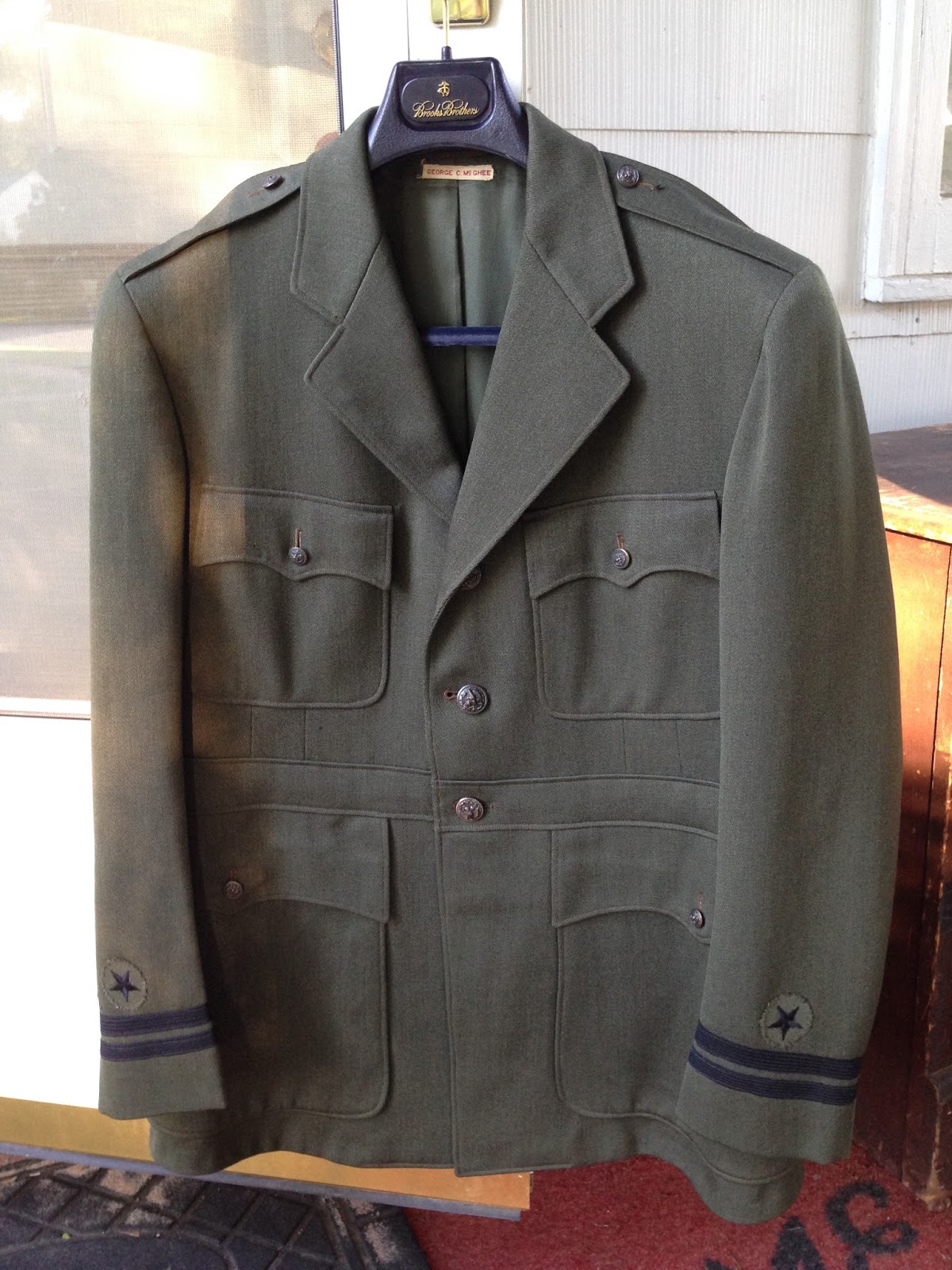
George C. McGhee WWII Navy Air Intelligence Officer Uniform

        WWII Navy Air Intelligence Officer Uniform ID`d to 

Ambassador George C. McGhee


George C, McGhee Navy Air Intelligence Uniform Coat & Trousers


Both custom tailored coat and trousers have custom name tag sewn in. The number A10449 is inside the coat sleeve and underside of front trouser pocket. McGhee is in faded ink on inside trouser pocket as well as other numbers. There are a few moth holes on both pieces.  Ambassador George Crews McGhee (1912-2005) was a Rhodes Scholar, oil entrepreneur, naval officer, statesman, diplomat, and philanthropist who became a central figure in postwar American diplomacy by helping to create and shape U.S. economic, military, and petroleum ties from Europe to the Far East. Over the course of his long career he served four presidents, Truman, Eisenhower, Kennedy, and Johnson, and twice served as ambassador.
At the outbreak of World War II George Crews McGhee entered the service of his country as a staff member in the Office of Production Management and on the War Production Board. He made his biggest contribution serving as a naval air intelligence officer in the Pacific on the staff of General Curtis E. LeMay. This service earned him the Legion of Merit in 1945. After the war, McGhee  joined the State Department in 1946. 8th United States Ambassador to Turkey, 4th United States Ambassador to West Germany.
Lt. Rank on sleeves


Custom Tailored Name tag sewn in both uniform pieces


WWII
"The next three months (November 1944 through January 1945) were frustrating, to say the least. Schools worked hard to train the lead crews, determined to improve bombing accuracy. Enormous efforts were made to upgrade maintenance. The depot had to start all over again, and in the meantime the air supply from Sacramento had to be improved. More missions were run against Japanese engine and aircraft factories. But the weather was a terrible opponent, and there was no intelligence of its movements. Japanese fighter opposition was desperate but not deadly, at least in comparison with German fighters. Air kamikaze-ramming tactics were tried with some success. Morale was a critical problem. The airplane engines were still unreliable. Aircraft disabled from combat or other causes were 1,500 miles from friendly territory. The crews had the choice of drowning or bailing out over Japan, to be executed by maddened Japanese. The U.S. Navy contributed tremendously to morale by stationing rescue submarines at intervals along the route. Their performance was superb. One submarine entered Tokyo Bay in daylight and picked up a B-29 crewright under the guns of the Japanese. From November 1944 to August 1945, 600 Twentieth Air Force flyers were saved in open-sea rescues. The system involved Navy flying boats, B-17s (Dumbos) carrying droppable lifeboats, B-29s (Superdumbos), and submarines, all under Navy control. The system was largely the achievement of my Navy Liaison Officer, Comdr. George C. McGhee."
Reference: The Strategic Air War Against Germany and Japan: A Memoir Haywood S. Hansell, Jr. USAF Retired


Photo from Sooner Mag Sept. 1946 article "With the Armed Forces"


Label over inside coat pocket
At the beginning of World War II McGhee was a member of the staff of the Office of Production Management and a member of the War Production Board. Commissioned into the U.S. Navy, McGhee served as a naval air intelligence officer on the staff of Army Air Force General Curtis E. LeMay, for which he was awarded the Legion of Merit.

Lt. Rank

Inside coat sleeve

A10449 written inside coat sleeve

Matching Trousers

Custom Tailored Name tag sewn in both uniform pieces

A10449 written inside both uniform pieces

Back of trousers
1943 Commissioned and Warrant Officers of the United States Naval and Reserve

Uniform has been lost for years. McGhee`s Officer's Dress Blue Uniform and Hat are on display at Cold Harbor Antique Mall in Mechanicsville Virginia.
This piece of history is for sale at SundayHistorical.com and will help me continue my project to bring great historical items to light. My hope is that a military or other collector will buy this uniform and donate it to a museum for all to enjoy. Serious collectors please contact me at info@sundayhistorical. 

It can be purchased on my eBay Store Blueprinter1995 (Item ID: 131916891825)


10%
of the sale of this item will benefitHire Our Heroes

The mission of Hire Our Heroes (HOH) is to empower transitioning veterans with the knowledge, skills, and innovative tools necessary to secure employment after serving our country.


Great work is being done in the State of Virginia by The McGhee Foundation: The mission of The McGhee Foundation is to continue the educational and humanitarian legacy of U. S. Ambassador George C. McGhee (1912-2005) by supporting projects and programs that provide inspirational learning opportunities and enrich the lives of residents in the Virginia Piedmont area.
References:

Sunday, July 19, 2015

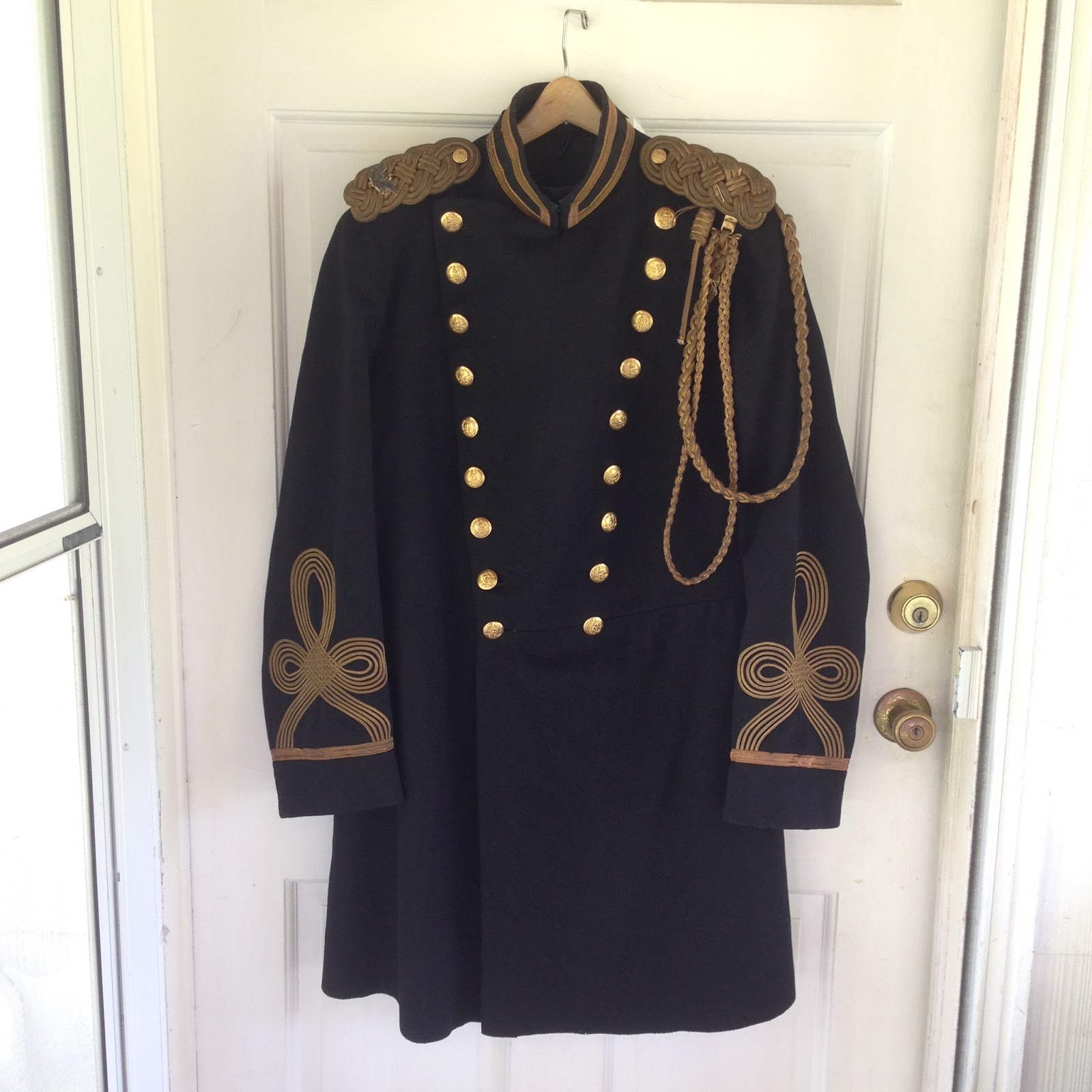
Virginia Volunteers M1902 Dress Frock Coat
Colonel & Aide de Camp

Identified officer was Colonel & Aide de Camp to Governor E.L. Trinkle. See photo below of Register Officers Virginia Volunteers from State Archives at the Library of Virginia. Officer listed as "Colonel & Aide de Camp, staff of Governor & Commander & Chief" This officer, Irving Vallandigham Parham was a prominent citizen of Petersburg Virginia. He was one of several civic leaders who were instrumental in having Camp Lee built at the present Fort Lee site in WWI. He lost his right hand and possibly part of his arm around 1913. The shoulder cord is on the left shoulder as found. Not sure if this because of the missing limb or if it is historically correct. Parham served on the Chamber of Commerce, was Mayor of Petersburg, but resigned to become City Treasurer, where he remained for 30 years up until his death in 1961.


M1902 Pattern 


This beautiful uniform and Governor`s Staff photo can be seen in my space at Cold Harbor Antique Mall in Mechanicsville, VA.
It can be seen anytime at my online store sundayhistorical.com


Below is page 129 of the register of officers in the Virginia Volunteers.
Register Officers Virginia Volunteers from State Archives at the Library of Virginia


The obituary for I. Val Parham in The Progress-Index newspaper is provided as a source of background information and it contains his photograph.
Obituary for I. Val Parham 1961

I. Val Parham`s cousin Henry V. Parham was Captain of the Petersburg Guard in 1917.
Add  5 strand heavy bullion quatrefoil of a Colonel


Virginia State Seal Buttons
Colonel rank eagle on shoulder knot

Back view of coat showing 4 buttons

Typo on first initial

Tuesday, June 23, 2015

Early 1900`s Railroad Supplies Johnson Mfg. Co. Diamond J trademark


      Example of Early 1900`s Railroad Supplies
         Atlantic Coast Line Railroad Tin Cup
Johnson Manufacturing Co. Urbana Ohio
Diamond J trademark

This blog was written to help others with their research on old tin and galvanized iron railroad artifacts with the Diamond J trademark and give a basic manufacturing date window. Sellers and buyers may find this information useful.

The Diamond J trademark belonged to the Johnson Manufacturing Company of Urbana Ohio. Here is a photo of the trademark.


Diamond J trademark

This trademark is on the bottom of a tin cup that is stamped ACL RR. The Atlantic Coast Line Railroad was in operation from 1900 until 1967, when it merged with longtime rival Seaboard Air Line Railroad to form Seaboard Coast Line Railroad.


Buy This Item


see all railroad items

Here is the text taken directly from the Historical Marker at the old Johnson Manufacturing Company building in Urbana Ohio.

" The Johnson Manufacturing Company was incorporated in 1902 by brothers James B., J. Will, Isaac T., and Charles F. Johnson, all of Quaker heritage. The company manufactured tin and galvanized iron ware for railroad lines across the United States. The initial product was the No. 1 long-spouted locomotive oiler with the patented dripless spout. That was quickly followed by other types of oil cans, signaling equipment, engine buckets, tallow pots, torches, track inspection devices, tin cups, and caboose and cabin car lamps, all carrying the Diamond J trademark. The makers created the patterns and everything was cut, riveted, and soldered by hand. As production expanded, the original frame building at 605 Miami Street was replaced by a brick structure in 1910, the southernmost part of the present building. Subsequent additions expanded capacity and the Johnson Manufacturing Company became a national leader in the manufacture of railroad operating supplies. During the Great Depression, the Roll Rite cigarette roller, poultry waterers, and hygrometers were produced from patented Johnson designs. About 1939, the firm turned from railroads to the trucking industry, designing and manufacturing air and vacuum reservoirs for brake systems. In the 1970s, during the presidency of Charles F. Johnson III, the historic original building was restored, a product museum created, the 75th anniversary of the firm celebrated, and a permanent collection of original art, including work by Champaign County artists, hung in the firm's offices to honor the heritage of the company and the community." 
Notes: The Johnson Manufacturing Company, abandoned and overgrown.
As you can see after reading the company history above, they manufactured railroad operating supplies from 1902 until the late 1930`s. I found this to be a very good source of information.

Recently, I sold one of these cups (I have 3) on eBay. The buyer said it was not old and wanted to return it and claimed it was not as described. Here is the buyer`s comment on the return form:

" I ve communicated with the mayor of Urbana, a major RR collector, and a sheet metal company. Though they may be incorrect, the consensus is the cup isn t as old as listed. An identical cup with a paper label for March of Dimes dated 1949 recently went unsold on e-bay."

I sent the buyer this history to prove my cup was from the early 1900`s and told them that their sources were wrong and that comparing a March of Dimes cup with a Railroad cup was like comparing apples to oranges. The 1949 March of Dimes cup was probably made from the retired railroad cup pattern that was no longer being used.

I hope some may find this amusing, as I am trying to see the humor, instead of taking ownership of it.

The pitfalls of trading on eBay are quite tiresome. While I reap the benefits of the millions of people who view my items, the ones that abuse the system and the few actual crackpots I have encountered make it questionable.

I am also hoping that from this blog I can let it be known that I have a web store of my own.
If you are looking for railroad, military, vintage watch parts and other collectibles, please visit my web store Sunday Historical. I sell genuine items. There are also reproduction items available. I try to give a history of the item if it is available, hense, the name Sunday Historical. If you don`t want to click on a link, paste www.sundayhistorical.com in your address bar.

Thanks for viewing this blog and your comments are welcomed.

Saturday, January 24, 2015

Albert F. Jahnke Pocket Watch Survives in Richmond VA

   Several months ago, a friend, one of the most experienced Jewelers in Richmond, showed me a pocket watch that an elderly friend wanted to sell. My friend Amy Shady knew how much I liked pocket watches and history and thought I would appreciate seeing it. I was intrigued from the moment I saw it. It was a ladies pocket watch with a dial that was marked "Jahnke Richmond VA". I had to begin research right away. Jahnke Road was about a mile from my house. I always wondered where the name came from, but never looked in to it.

My research took me to the Jahnke Family Page on Rootsweb.ancestry.com. I have provided the link here.  http://freepages.genealogy.rootsweb.ancestry.com/~bensonarchives/JahnkeFamilyArchives/jahnke_family_page.htm

Albert F. Jahnke, Sr., was born 1826 in Prussia.  According to several newspaper articles, he immigrated to New York in 1848, stayed there for two years, moved to Petersburg Virginia and two years later moved to Richmond. He was a partner in a jewelry business called Myers & Jahnke. The The 1881 Richmond City Directory lists the store at 1201 E. Main St. The Virginia Select Marriages 1785-1940 lists his marriage to Mary B. Chaulkley Sept. 3rd 1859 in Henrico County. 1893 Richmond City Directory lists Albert F. Jahnke, watchmaker at 912 E Main Street in downtown Richmond and home in Chesterfield. He brought jeweler and watchmaking skills from Prussia.
   Below is page 145 from a book published in 1903 "Richmond Virginia: The City on the James: The Book of Its Chamber of Commerce" with a photo and small bio (upper right). This book was digitized by Google and can be found in Google Books. The bio reads A.F. Jahnke , Founder of the business of Jahnke Bros., now conducted by A.F. Jahnke, Jr. Watchmakers, Jewelers and Opticians, 912 East Main Street. Established 1852. Fine Watch Making and Optical work a specialty. Largest stock of watches in the city. Agents for Patek, Phillippe & Co.
 Albert F. Jahnke, Sr. ran the business until 1890. His two sons ran it under the name Jahnke Brothers until their deaths. His daughter Minnie was the first woman jeweler in the state of Virginia and finally closed the business in 1952, a 100 year run.
 In the 1915 Richmond City Directory his residence is listed as the Virginia Building, which was an apartment building. He died there on November 27th 1915. He was the oldest jeweler and mason in the state.


Thanks to a descendant of Albert`s wife Mary`s side of the family for emailing me this Richmond Times Dispatch article from Sunday, February 8th 1953, page 89.

The Jahnke Farm taken 1/31/2015

Taken from Jahnke Road 1/31/2015

The pocket watch was purchased new and given to a young lady when she was about 18 years old. It is a Swiss movement with a serial number 1232259. The dial and movement ordered from the Swiss maker and are marked Jahnke Richmond. Then the customer would choose a case to hold the movement. The owner gave it to her friend who is now in her 90`s.
The case is gold filled, although marked 14K. Information below on the case was gathered from NAWCC:
James Boss patented the "gold filled" watch case in 1859. A JBoss marked watch case it will be "gold filled" and not 14k solid gold.
The Keystone-Watch-Case Co. purchased the patent and trademark rights for the JBoss case from the previous owners and used it with their own trademark.
After Jan. 1, 1924 a "guaranteed" marked case was prohibited by the U.S. Govt. They were only mark 10 or 14 "gold filled" after that date.

The pocket watch was taken to a jeweler at some point in recent years to be appraised. The watch was butchered by the jeweler. The front and back case are bent. The crystal is missing, and the previous owner stated the jeweler stole the jewels out of the watch. There ought to be a law.

I bought the watch from the second owner so I could do some research and more than likely have it on display in my Antique Booth at Hickory Creek Antiques in Ashland Virginia. I had a reputable jeweler/watchmaker there give an estimate of $1800.00 to restore it. They seemed to think it was from around 1880. I was thinking 1900. I`d really like to raise the money to have it restored.

What a piece of Richmond History! Enjoy the photos.

Beautiful dial & hands

Front cover

Keystone Watch Case

Engraved with owners`s name

Swiss Movement

Marked: Guaranteed J BOSS 14K 25 Years

Front case: note damage

Missing crystal

Movement marked Jahnke, Richmond, VA.
Anyone interested in seeing it should contact me through this blog or at SundayHistorical@gmail.com. I am hoping someone can identify the movement without me removing the hands and dial to look behind for a makers mark.

Thanks to my fellow jeweler and friend Amy Shady for making it possible for me to share this watch.

UPDATE MAY 26, 2016
I have connected with a non commercial watch repairman and the Jahnke pocket watch is being restored. I hope to have it back toward the end of the year.


Saturday, November 9, 2013

Artists at Work

                             Artists at Work

This blog is in celebration of two artists I have the pleasure of working with at the jewelry manufacturing facility here in our fair city, Richmond Virginia.

   The first artist is the first person I met when I came to work at the precious metals company. He is extremely talented and has since gone out on his own to make his way in this life using his hands. Greg has sold his work to The Mariners Museum Gift Shop and The Virginia Aquarium Gift Shop in the Tidewater Virginia area this year. Pieces can be purchased at the gift shops. Greg`s next show is  at The 10th Annual Ginter Park Arts & Crafts Show. Greg is waiting to hear from the Natural Bridge about another contract for work for their gift shop. Greg`s most recent work can be seen on his website at GregMontgomeryDesigns.com

Greg Montgomery  GM Designs
Born in Radford, Virginia, 1955, I began drawing at a very early age; as I began to grow the drawings became collages; as I matured the collages became objects. For the past 30 years, these objects have become my voice. 

Plate of Bobbie Pins

Greg Montgomery Designs


   The next featured artist is Daniel Dicaprio. I am very fortunate to work with Daniel and see some his personal projects being cast in our facility while he is managing production in the Bench Jewelers/Solitaires/Earrings assembly department. Daniel was featured in the October/November issue of American Craft Magazine. He produces work for a gallery in New York. You can learn more about Daniel and his work on his website DanielDicaprio.com

DANIEL DICAPRIO


            The pieces I make in wood and precious metals, explore my interest in adaptation. The forms I work with stem from plant and animal anatomy often combining different aspects from each. During my process of making, I am often reflecting on people’s roles in the living world. I think about how we evolved to the place we are currently, and what other possible changes could happen in the future. I consider my sculpture to be organisms on the beginning of their evolutionary path. Referencing what we are and where we came from, the pieces are created in recognition of the past, while alluding to the future. The process of making this work is as seductive to me as an artist, as I hope the work is for the viewer or wearer.

Colony Necklace


Whom Bloom

Thanks to the two featured artists for their beautiful work. Comments would be greatly appreciated

Thanks
 Laura Smith